
By Blayne Banting, DMin, PhD
Most preachers have encountered the experience in which members remark about the most memorable part of the sermon, and it was not what they expected. It was not the hard-won exegetical insight garnered by studious attention to the original language, or even the deft use of alliteration or assonance in the outline, but some personal anecdote that had captured both the imagination and memory of the audience. As important as solid exegesis and proper homiletical structure are to the sermon, they usually are not what grabs the attention of the congregation. There is something innately engaging about the more personal, intuitive aspects of the preaching event. Partly, at least, this is due to the dynamism of narrative form and how it invites and excites the collective imagination of the congregation, though their respective life situations might be vastly different. The symbiotic relationship between creativity and narrativity, especially in preaching, is the focus of attention in this essay.
Paul Scott Wilson suggests a helpful image to describe the tensive dynamic of the imaginative/creative process:
Imagination in language is like this spark between the poles of the generator. The spark of imagination happens when two ideas that seem to have no apparent connection (standing “poles apart,” we might say), are brought together. Two conditions are necessary for imagination: (1) some connection between the ideas must be possible and (2) the ideas chosen must not be almost identical, for then they would function like the touching wires that had no visible spark.[1]
It is the intent of this essay to bring the two poles of creativity and narrativity close enough to spark thought in relation to the preaching event. This requires attention to understanding the dynamics of creativity since few preachers have given it thorough study. The dynamics of narrativity will be placed in juxtaposition, close enough to discover how creativity contributes to impactful narrativity in the preaching of biblical texts.
The Landscape of Creativity
The fascination with creativity is as old as ancient philosophy and recent as contemporary neuroscience. The pedigree of creativity and its cognate term imagination have a chequered past, however. Warren Wiersbe outlines a whirlwind history of imagination/creativity, showing how imagination/creativity has been viewed in the past. Plato denigrated imagination as producing mere imitations of earthly rather than ideal and eternal things. Ancient Judaism was suspicious of imagination for its connection to images and therefore idols and idolatry. Medieval Christianity saw imagination as a dangerous distraction toward worldly matters rather than heavenly. Renaissance and Romantic thinkers hailed imagination as capable of creating reality and many today consider imagination as a means of interpreting it.[2] The fortunes of imagination/creativity have risen and fallen over the years with no overriding consensus. Similarly, the debate whether imagination/creativity is a matter of nature or nurture, or a combination of the two, rages on.
A helpful beginning would be to define the terms involved. Although creativity and imagination are often considered synonymous, there is a subtle but important difference between them. Imagination (and its cognate terms, image and imagine) speak of the capacity of perception. Neuroscientist Iain McGilchrist concludes, “Imagination is the path whereby our eyes are opened so that we see something, for the first time, as it really is – at least as close as we can ever know.”[3] Creativity (and its cognates create and make) tends to relate more to the inventing of something new in light of broadened and generative perception. I have noted elsewhere that, “imagination is a way of perceiving and creativity is a way of conceiving.”[4] Nonetheless there is an intimate bond between the terms as together they are:
…the capacity to shape or order a new form of reality by perceiving new qualities in things and discovering previously unseen relationships between things. It is the creative interplay between discipline and freedom, convention and innovation, time and timeliness, work and playfulness (creation and re-creation).[5]
For practical purposes, therefore, this essay will assume that perception and conception should not be sharply bifurcated but be maintained in a synecdochical relationship.
Contemporary conceptions of creativity are often informed by neuroscience and the study of right- and left-brain hemispheres. The common understanding is to “side” with the right hemisphere as the source of creative thought and relegate the left hemisphere to linear and logical thought processes.[6] McGilchrist, however, nuances this understanding to include a type of time-sensitive synthesis between the hemispheres:
Thus, though the left hemisphere has a role to play during the later implementation of a creative insight – what I call the translational phase – it tends to impede during the generational and permissive phases, which correspond to what most people mean by creativity. There seems to be a marked increase in reliance on the right hemisphere among the highly creative, compared with the averagely creative, and not observing this distinction in experimental design has sometimes muddied the waters of research into hemispheric differences. Nonetheless, there is a very large body of evidence suggesting that the right hemisphere plays the key role in creativity.[7]
What begs further exposition is how both hemispheres of the brain operate in the process of creative thought. Creativity seems to be the generative interrelationship between the creative person, the creative product, the place or environment where creativity flourishes, and the creative process which produces that creative artifact. While these four components are integral to the creative expression, and each have theories highlighting their particular contribution to creativity,[8] the priority in this essay will be on the creative process itself.
Two conceptions of this process can be placed in conversation: Iain McGilchrist, neuroscientist[9] and Craig Skinner, homiletician.[10] Priority will be given to McGilchrist’s conception, due to its breadth of research and contemporaneity, with ancillary comments provided from Skinner and a few other voices.
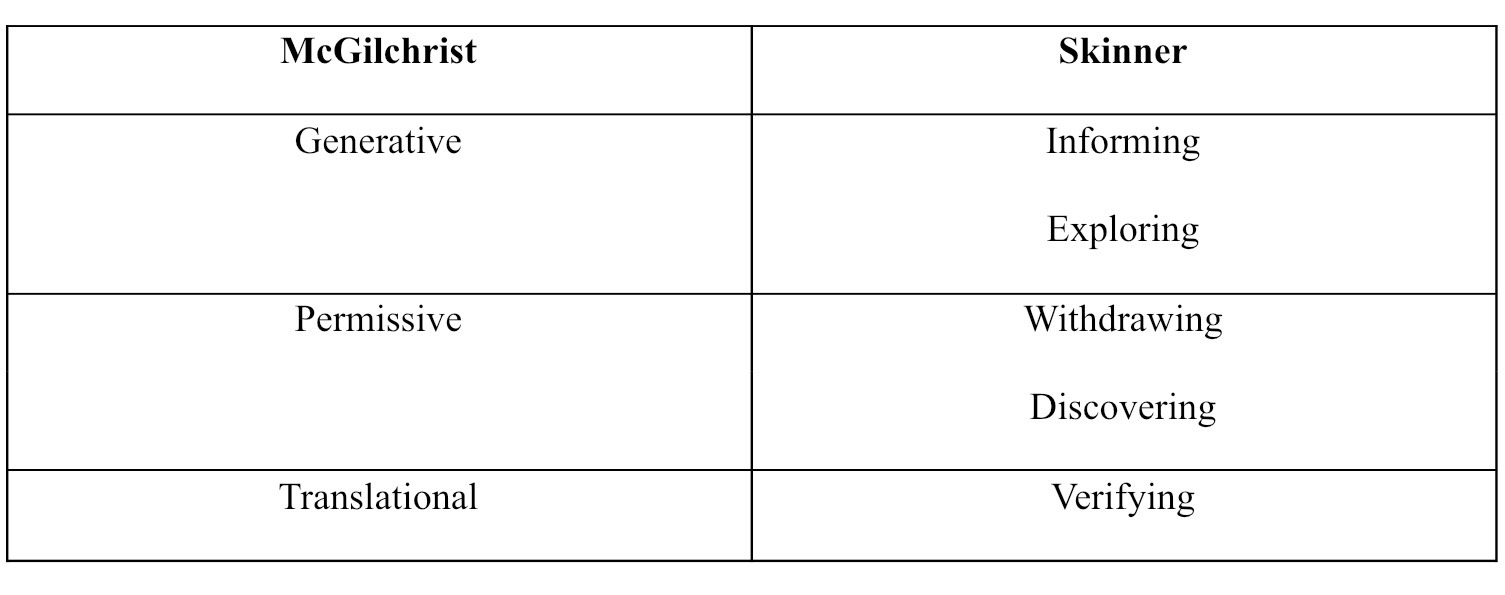 The process for McGilchrist begins with generative requirements. This is the lifelong cultivation of divergent thinking which encourages broad and spontaneous ways of perceiving/imagining—an openness to ambiguity, flexibility, and possibility. It is the opposite of thinking in a straight line; rather one is able to think in circles, spirals, bunny trails and detours, and goes cliff diving and parasailing. He notes:
What divergent thinking covers is not just being able to make up new ideas at random – but perceiving connexions and shapes or forms that guide thinking by analogy: to broaden a field that has become too narrow, or to find alternative ways of visualising something that has become too familiar.[11]
Skinner seems to bifurcate this initial movement into Informing (defined as the “…process of collation every fact or idea considered is to be accepted without any judgment as to its relevance.”)[12] and Exploring (“a penetrative investigation of all the latent associations available between the facts and materials gathered under [Informing].”).[13] Much of this movement is subterranean within the subconscious and pre-verbal realms. As Arthur Koestler notes, “true creativity often starts where language ends.”[14]
McGilchrist’s permissive requirements of the creative process allow uninterrupted space and time for the serendipitous to erupt.
We can’t make creativity happen, but we can certainly do our best to stand in its way. Or therefore not. Furthering creativity is mainly about not doing, rather than doing. The only useful thing to do is relax and to avert the mind’s eye. Then it will come of its own accord.[15]
Skinner again bifurcates this part of the process into Withdrawing (defined as “…a complete (although temporary) abandonment of the task and a total surrender of it to the inner creative self.”)[16] and Discovering (where “… spontaneous intuitive discernments commonly arrive as ecstatic ‘aha’ experiences.”).[17] Koestler refers to this as incubation: “The period of incubation is a similar retreat, if not into the womb, at least into long-outgrown forms of ideation, into the pre-verbal, pre-rational games of the unconscious.”[18]
Preachers short on time and unfamiliar with the process might be tempted to a premature employment of left-hemisphere analysis before the new creation bubbles forth. John Cleese, with his biting wit, advises that, “when you first have a new idea…don’t get critical too soon. New and “woolly” ideas shouldn’t be attacked by your logical brain until they’ve had time to grow, to become clearer and sturdier. New ideas are rather like small creatures. They’re easily strangled.”[19]
McGilchrist posits translational requirements as the culmination of the reiterative process of creativity. He demonstrates the relationship between the permissive and translational requirements as “a phase of exploration guided by the imagination; followed at a distance of anything from seconds to months, but in any case followed, by a critical sifting and evaluation of the results.”[20] Skinner’s correlate is Verifying which is virtually identical to that of McGilchrist.[21] At this point the interconnection between left and right hemispheres of the brain is evident, and calls for the creative preacher to sift through all that has emerged for the purposes of separating the wheat from the chaff, the engaging from the tantalizing, the orthodox from the heterodox.
The temptation to dissect and quantify this process to replicate it for frantic preachers who are looking for “that” creative story (on Saturday evening) to communicate a sermonic truth, within the confines of a busy pastoral ministry, is to be resisted as a chasing after wind. McGilchrist warns, “You can’t make the creative act happen. You have to do certain things, otherwise it won’t happen. But it won’t happen while you are doing them.”[22] “Creativity is less a ‘what,’ a thing that is done, than a manner in which whatever it may be is approached.”[23] Harried preachers who long for the missing ingredient to elevate their preaching to the next level, or resonate in the collective recollection of the congregation longer than it takes to clear the parking lot, will not find an easy solution here. What remains to be explored are the benefits which creativity might bring to preaching should the preacher bend to its nature and discipline.
Creativity and Preaching
Creativity is less panacea than perspective. Preachers desiring to become more creative should dedicate the requisite time and discipline to develop a more creative perspective. Creativity may be a costly commitment given the current cultural expectations of efficiency and productivity within many ministry contexts. To preserve space in this essay and prepare for a comparable chart of the benefits of narrativity for preachers, these values are presented in chart form. The following value-functions are ones particularly applicable to the preaching event (for both preacher and congregation/listeners).
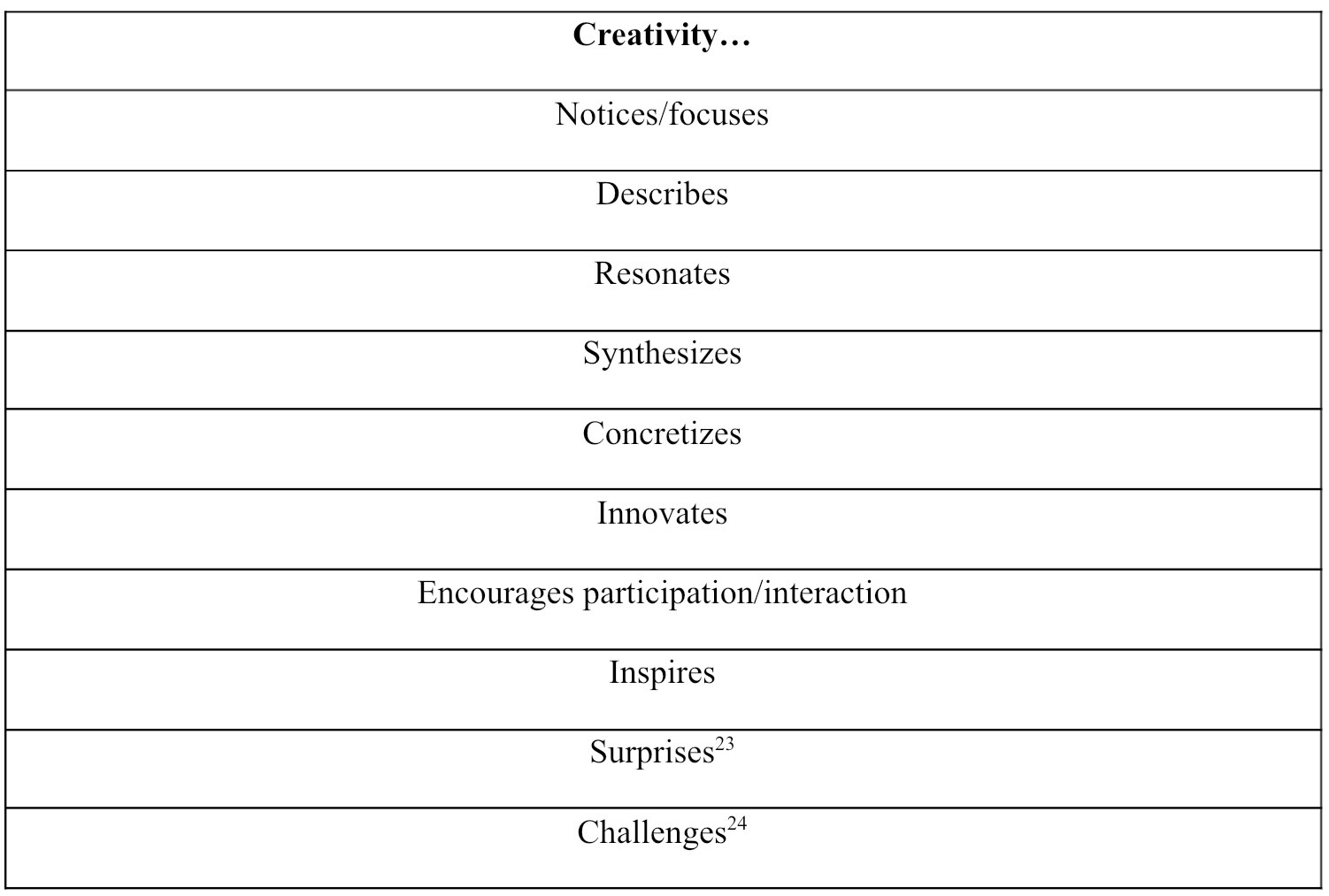 At this point, creativity, the first of the two poles has been developed. What remains is to repeat the process for the narrativity pole to see if there is indeed sufficient spark to encourage their synthesis in preaching.
The Landscape of Narrativity
It is becoming increasingly evident that humanity lives in a storied world. The unprecedented rate of technological change is giving birth to an attendant desire for something more, something beyond the material and 1s and 0s. Enter the ancient discipline of storytelling, a premodern aspect of reality hard-wired into humanity from times past. When congregants seem more attuned to narrative portions of the sermon, they are only reacting as their forebears have for centuries. The “recovery” of story bears testimony to the longing for resonance with something of ultimate significance. In the words of Daniel Schwabauer, “[t]he basic elements of every story are whispering to us, in narrative form, about a reality that is larger than a purely material cosmos.”[24]
Using the narrative elements of theme, context (setting), characterization, voice (perspective), and plot, narratives weave an alternative reality to which listeners are drawn and taught through “indirect emotional resonance.”[25] The level of learning is related to the skill of the storyteller and the degree of imaginative identification by the listener(s) with the world created by the story. The same story might have differing levels of engagement, from apathy to entertainment to transformation. The words of Jesus state the case:
To you [the disciples] it has been given to know the secrets of the kingdom of heaven, but to them it has not been given. For to the one who has more, more will be given, and he will have an abundance, but from the one who has not, even what he has will be taken away. This is why I speak in parables, because seeing they do not see, and hearing they do not hear, nor do they understand (Matt 13:11-13 ESV).
To some, the parables of the kingdom were quaint stories about fish and sheep and mustard seeds. To others they were enigmatic tales that aroused both curiosity and confusion. To the initiated (and coached), they spoke of the upside-down reality of the Kingdom of God. So, the difference between being bemused, amused or transformed comes, in large part, from the posture of the listener. In Schwabauer’s words, “The prerequisite for receiving from him is believing in him.”[26] The impact of any story is found in the tension between the skill of the storyteller and the posture of the listener. There is no failsafe to a “killer” story which has the same effect on everyone in the room. Storytellers must admit the discrepancy between the agency they have in crafting the story and in creating the conditions by which the story has maximal impact.
A factor which may mitigate this tension is the development of broadened perception in both storyteller and listener. This development sounds strikingly similar to the role of creativity/imagination discussed above. In the storyteller it might be seen in the capacity to be open to new perceptions through generative and intuitive capacities. Alyce McKenzie labels this capacity as a Knack for Noticing (KFN):
Fiction writers and preachers need, not just to see, but to notice. We need, not just to walk by life with glazed eyes, but to hone in on daily sensory details, noticing and recording them for future uses we can’t yet predict. We need to pay attention to our inner life (inscape), life around us (landscape), and the life of the biblical text (textscape).[27]
Enhanced receptivity within the listeners comes with their realization of their needs that are addressed by the “world” of a particular story. Homileticians note that Scripture does indeed address these significant existential/spiritual concerns as integral to their purpose. Bryan Chapell refers to this as the Fallen Condition Focus (FCF) and calls the preacher to ask of the preaching text, “Why are these concerns addressed? What caused this account, these facts, or the recording of these ideas? What was the intent of the author? For what purpose did the Holy Spirit include these words in Scripture?”[28] I have referred to this elsewhere as the Deep Need Addressed (DNA), since there “are common matters of need that come from being sinful yet redeemed children of God, no matter what, where, and when we live.”[29] The insightful and caring preacher will not only discern this purpose within the biblical text but apply it to the needs within the gathered congregation.
Alongside these more general comments regarding the nature of narrativity, there are specific ways in which narrativity dovetails with the preaching event from both the ancient context of the biblical texts themselves to the contemporary contexts of the preacher and the hearers. This would include the more recent development of narrative theology. To be clear, narrative theology is not identical to narrativity as understood for purposes of this essay. Narrative theology is:
a theological approach that utilizes the concept of story and the human person as storyteller (e.g. Gabriel Fackre, Hans Frei, Stanley Hauerwas, George Stroup) to provide the central motif for theological reflection. Narrative theologians claim that we construct our personal identity as our individual stories are joined with the transcendent story of the religious community and ultimately with the overarching narrative of salvation history.[30]
There are homileticians who have adopted the narrative theological perspective to the point that they insist all sermons adopt a narrative (or plotted) form.[31] The prevailing influence of narrative structure and logic is pervasive in scripture, but it would be reductionistic to mandate a narrative form for every biblical sermon since other textual forms are found throughout the canon. It would be closer to reality to state that all biblical texts and the sermons developed from them are informed by narrative rather than formed by narrative. This reality is merely to say narrative can be employed in sermons by preachers even when the form of the biblical text or the sermon takes a differing form.[32]
Notwithstanding the opposition to the homogenizing effect of throwing all the canon into a narrative blender, it is important to trace the various ways narrative informs the nature and structure of the canon and the preaching event. What follows is a discussion of the various ways in which narrative influences the reading and preaching of the Scriptures.
First, every biblical text (and indeed the entire biblical canon) has a story. Each biblical text, regardless of its genre, has a story under it, a metanarrative that gives unity and movement, telling the story of the Bible from creation to consummation. Several versions of this overarching narrative can be found, but the following chart depicts an enhanced comedic story arc (which is preferable to a tragic one!):Adapted from Blayne A. Banting, Take Up and Preach (Wipf and Stock, 2016), 65.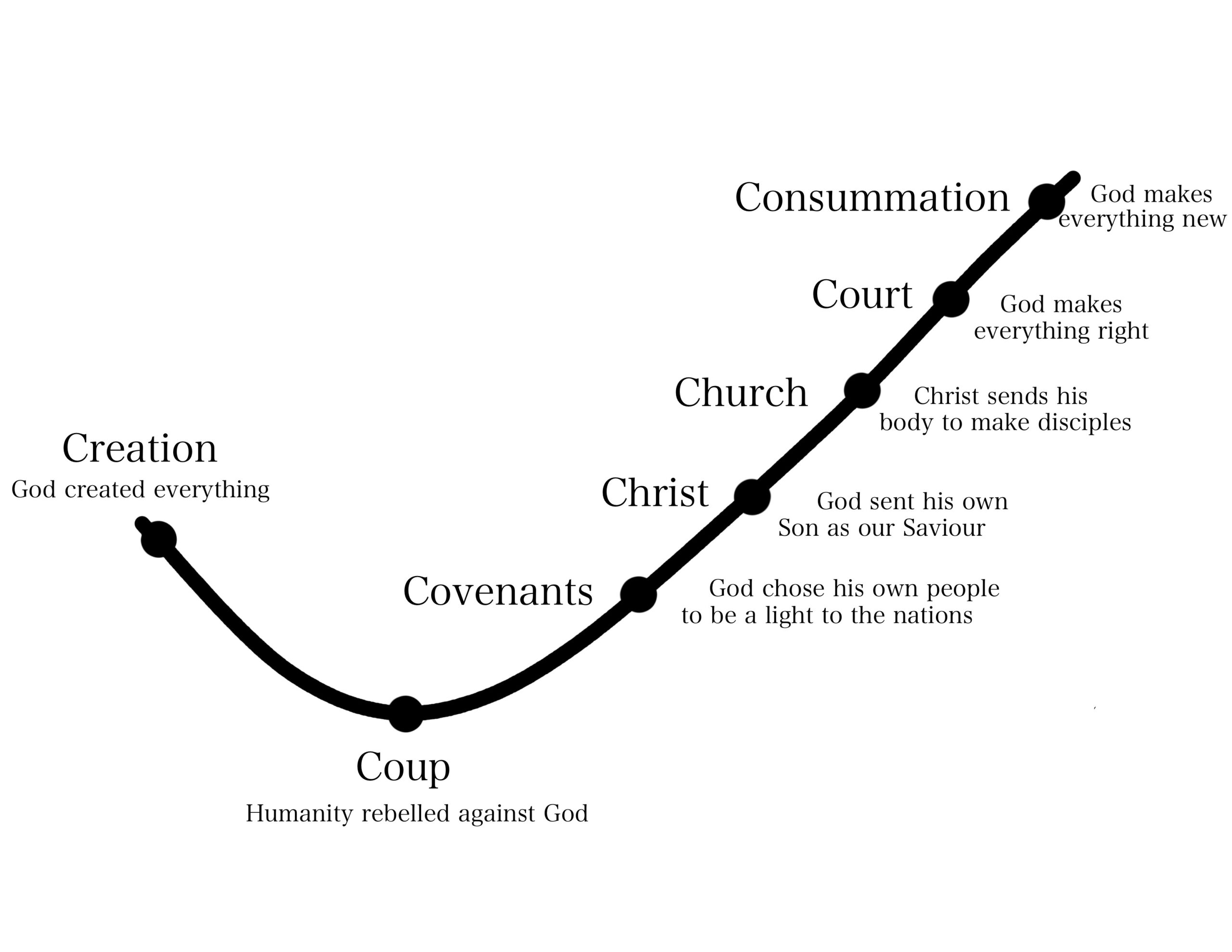 Since all scripture communicates this larger narrative, preaching requires the preacher to attend to the point within the larger metanarrative which serves as the historical context of the biblical text being preached. In Schwabauer’s words, “The Bible isn’t just a collection of stories. It is the story—the one true story to which all are invited.”[33]
Second, every biblical text has a story behind it. Each text comes from a particular historical, cultural, and linguistic context. Even texts without a shred of narrative form have come into being through a situation that tells a backstory as to why this text was penned in the first place. Biblical authors did not simply shoot texts into the atmosphere as eternal missives fit for every space and time—they come encased in the soil, language, and intentions of the original context. Even when it is difficult or even impossible to determine the historical background of some texts, it is helpful to remember every text came clothed in the garb of another place and time.
Third, every text has a story in front of it. The text relates to the contemporary context of the community gathered to hear this text expounded and applied to them and their concerns or needs. If the story behind the text reveals the ones written to originally, the story in front of the text speaks to those whom the text is written for. The preacher who attends carefully to the historical context of the text without understanding the hopes, dreams, and challenges of the gathered congregation will be treated to a chorus of yawns. To label these needs as congregational exegesis seems to blunt the flesh and blood history of a worshipping body of believers and uses academic categories to describe an interpersonal gathering. Most congregations do not want to be analyzed as much as they seek to be understood and valued—an approach natural to narrativity.
Fourth, every text has a story within it. Each text is birthed through the inspired author’s own capacities, background, and choices of genre, vocabulary, structure, and what to include or exclude in the text itself. While the inner machinations of an ancient author may not be crystal clear to the modern reader, it is helpful to remember that every text is intended to accomplish something and inevitably is part of the personal inscape of the author.
Along with the narrative quality of the biblical text itself, Christian worship, of which preaching is usually a part, also takes a narrative form. Every sermon has a story around it. The flow of a congregation’s liturgy, whether it is formal or informal, tells a story that animates the worship lives and experiences of the worshippers. The elements of space, time and plot, which are basic to narratives, are also integral to worship. Worship has a setting since it happens somewhere, even in the case of online worship (which both multiplies and dilutes the special qualities of corporate worship). There is a time element to worship since it happens at some time—both in the micro sense of the various times of day when a congregation gathers to worship, and the macro sense of the larger temporal context of the church year which informs the church of a larger story informed by the story of Jesus himself. There is also a plotline to corporate worship as the church gathers, remembers, proclaims, celebrates/gives thanks, and then goes forth in mission.[34] All these factors, general and specific, inform the preacher’s role in employing narrativity to enhance possible sermon impact.
Not to be ignored in this discussion, of course, is the reality that more than half of the scriptures is given in various narrative genres and employs a full array of narrative structure and rhetoric. The wide variety of narrative techniques within the narrative portions of scripture is a testimony to the creativity implicit within the narrative genres themselves.[35]
Narrativity and Preaching
Two factors aid the preacher’s capacity to use narrativity in preaching to enhance its impact. Alongside aspects of narrativity outlined above, there has been a resurgence among preachers to develop the skills required to become good storytellers.[36] What remains to demonstrate is how the value-functions of creativity relate to those of narrativity to suggest How do they might cooperate in developing powerful and memorable preaching moments? A comparative table of their respective value-functions follows so that potential points of interactive generativity might be identified.
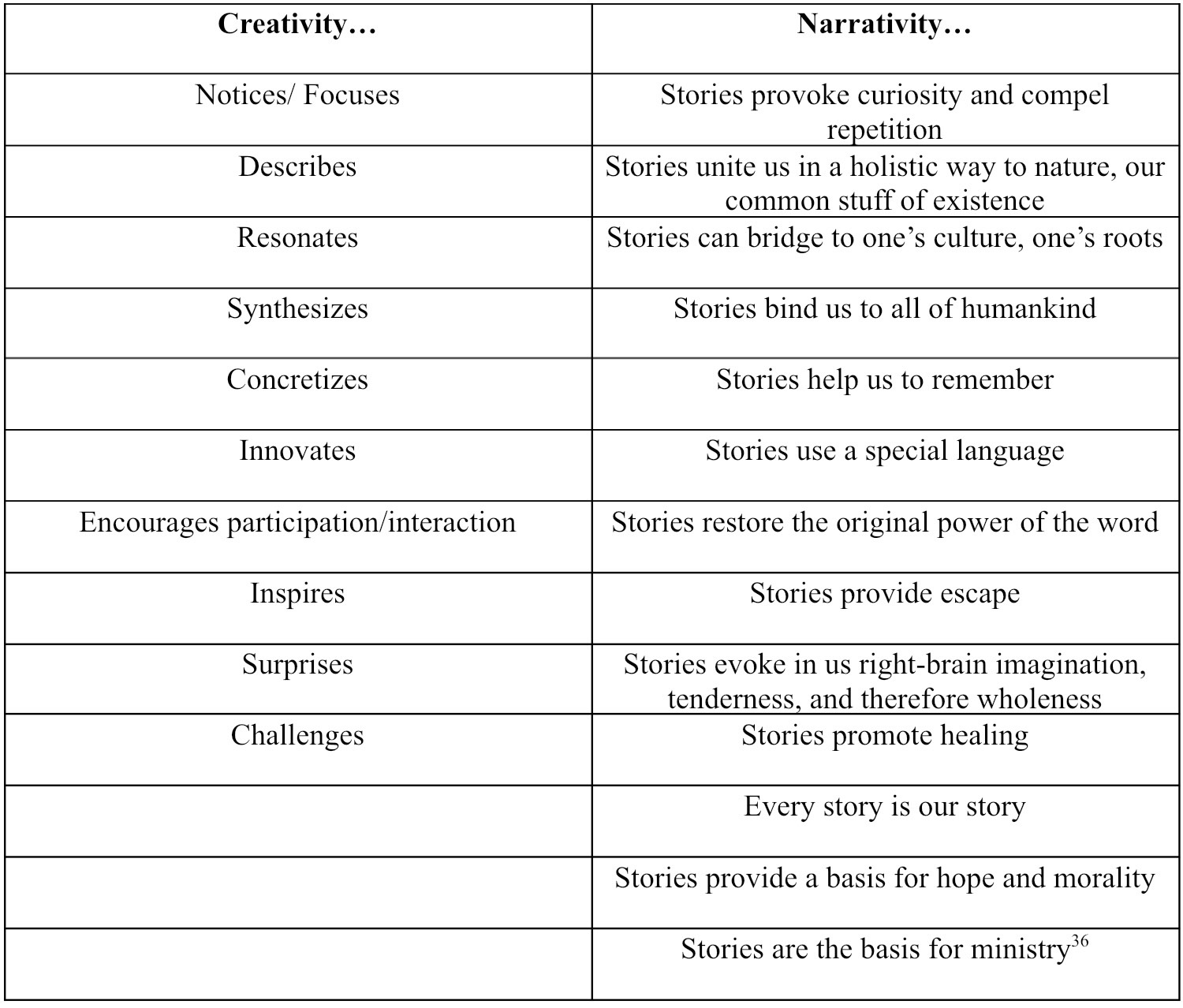 A cursory scanning of this comparative table suggests several possible affinities. They are not identical, but close enough to elicit some helpful energizing sparks. Both, in their own way, encourage human solidarity, emotional resonance, intuitive/ generative thought, collective memory, ethical engagement, and hopeful inspiration. The longer one contemplates these commonalities, the more obvious the dynamic interconnections appear. They inspire both the preacher and the listener to greater depths of engagement with what creative stories have to offer.
What each biblical text offers—a sense of wonder, a revelation of who God is, a truth to be told, a deep need addressed, possible responses to practice, and a future to be imagined—along with the basic building blocks of narrative—theme, context (setting), characterization, voice (perspective), and plot (beginning/anticipation, middle/conflict, and end/resolution) – are the raw materials of a powerful sermonic story. These rich resources are entrusted to the minds and hands of preachers to hone their craft.
A Tantalizing Taste
What might the process of creative storytelling in service of preaching a biblical text look like? Whether that might be a creative retelling/contemporizing of the biblical story or a juxtaposed story with a similar theme, understanding the dynamics above would entail the creative process of exercising the insights above. Taking Luke 19:1-10 as a sample text, what follows are some thought-provoking questions to help preachers with their knack for noticing (KFN). This method of slow and ponderous reading of the text might be described as rhetorically informed, imaginative lectio divina.
Jesus entered Jericho and was passing through. And behold, there was a man named Zacchaeus. He was a chief tax collector and was rich. And he was seeking to see who Jesus was, but on account of the crowd he could not, because he was small in stature. He ran on ahead and climbed up into a sycamore tree to see him, for he was about to pass that way. And when Jesus came to the place, he looked up and said to him, “Zacchaeus, hurry and come down, for I must stay at your house today.” So he hurried and came down and received him joyfully. And when they saw it, they all grumbled, “He has gone in to be the guest of a man who is a sinner.” And Zacchaeus stood and said to the Lord, “Behold, Lord, the half of my goods I give to the poor. And if I have defrauded anyone of anything, I restore it fourfold.” And Jesus said to him, “Today salvation has come to this house, since he also is a son of Abraham. For the Son of Man came to seek and to save the lost” (Luke 19:1-10 ESV).
Textscape Questions
What is significant about the timing of this story? Does it matter that it is very close to Jesus’s entry into Jerusalem? What bearing does the previous episode of the healing of the blind man have on this story? Does it matter that it happens in Jericho? Why? What time of day do you think it happened? What role does seeking (vv. 3, 10) have in this story? What significance does the name Zaccheus (pure) have? How would you describe Zaccheus to someone? Does it matter that he is rich and short? How would you imagine the crowd? Why would he climb a tree? Why a sycamore tree? How would that have looked? Why did Jesus call him by name? How did he know his name? Why did the crowd react the way they did? Why did Zaccheus react the way he did? Why did Jesus say that he must stay at Zaccheus’s house? What is significant about Zaccheus’s joy (19:6) and the crowd’s grumbling (19:7)? What does Jesus mean when he says salvation has come to Zaccheaus and his house? What are the implications of this salvation? Why did Zaccheus go beyond what was required in making restitution? How could Zaccheaus be a son of Abraham and part of a system oppressing Abraham’s children? What does this story teach about Jesus? What is the main focus/theme of this text?
Landscape Questions
How would the congregation describe Zaccheus’s occupation in contemporary terms? What is their response to rich people? Who would play the role of Zaccheus in their version of this story? If they were Zaccheaus’s therapist, what might they be helping him deal with? Why are people prone to think the worst of other people? Would the crowd’s reaction be different if there was no crowd, but only separate individuals? Do rich people have issues and challenges? Do short people have issues and challenges? How would those extorted by Zaccheaus in the past greet his commitment to repayment? If the congregation was a part of the crowd that day, how would they have reacted to seeing Zaccheus up in that sycamore tree? How would they have reacted to Jesus going to Zaccheus’s house? Can you think of other scenarios similar to this story?
Inscape Questions
Is the congregation more like Zaccheus or the crowd? Why? Why would Zaccheus want to see Jesus? Why was the crowd there? Does the congregation like Zaccheus? Do they like the crowd? How are they like Zaccheus? How are they like the crowd?
Every preacher will take these prompting questions in different directions, but each will have their sanctified imagination/creativity inspired and directed by the text and its nexus to the issues of everyday life. The resulting story will run in a tensive parallel to life in all its grit and glory and may indeed engage those with a mind to be encountered by the living Christ in ways they never saw coming.
Conclusion
The purpose of this essay has been to explore ways in which the interplay between creativity and narrativity might enhance the preaching event for those willing to invest the time to implement these tensive sparks within their sermonic preparation. The desired result should be more than spell-binding storytelling in the preaching event. Creativity and narrativity are not the only gifts given to faithful preachers – but they are powerful means in communicating the gospel.
Creativity and narrativity share an ‘enchanted’ affinity which can enhance preaching but that assumes an understanding of their respective contributions and the preacher’s commitment to employ them purposefully and ethically. All good gifts call for their proper use, and this is the challenging stewardship of all who obey the call to offer these gifts to the glory of God:
Great preachers, like great writers, must cast a spell. The greatest preaching must cost the preacher something. It is demanding. It respects language, tells old stories in new and dimensional ways. It is lightning and sun. Its vision and ethos linger powerfully in the senses and spirit. It demands the reading of tried and true novels [and other imaginative forms of communication] that makes the soul stand on tiptoe and stimulates hearers to delight, conviction, and transformation.[37]
Blayne Banting, DMin, PhD, is Associate Professor of Preaching and Christian Ministry at Briercrest College and Seminary. He has served churches in both urban and small-town contexts in Alberta, Saskatchewan and Prince Edward Island over a span of 21 years.
Author Copyright.
Banting, Blayne. “Creativity and Narrativity: The Role of Story in Preaching.” Northwest Institute for Ministry Education Research. www.nimer.ca (retrieved Date Accessed). Peer reviewed.
Bibliography
Achtemeier, Elizabeth. Creative Preaching: Finding the Words. Abingdon, 1980.
Arthurs, Jeffrey D. How to Preach Narrative. Fontes, 2022.
________. Preaching with Variety. Kregel, 2007.
Banting, Blayne A. With Wit and Wonder: The Preacher’s Use of Humour and Imagination. Resource, 2013.
________. Take Up and Preach: A Primer for Interpreting Preaching Texts. Wipf and Stock, 2016.
Bausch, William J. Storytelling: Imagination and Faith. Clear Faith, 2015.
de Rosset, Rosalie. “Felling the Devil.” In The Moody Handbook of Preaching, edited by John Koessler, 237-50. Moody, 2008.
Enyart, David A. Creative Anticipation. Xlibris, 2002.
Forbes, Cheryl. Imagination: Embracing a Theology of Wonder. Multnomah, 1986.
Green, Joel B. and Michael Pasquarello III, eds. Narrative Reading, Narrative Preaching. Baker 2003.
Hauerwas, Stanley and L. Gregory Jones, eds. Why Narrative? Readings in Narrative Theology. Eerdmans, 1989.
Jensen, Richard A. Thinking in Story: Preaching in a Post-literate Age. CSS Publishing, 1993.
Koestler, Arthur. The Act of Creation. Penguin, 1964.
Larsen, David L. Telling the Old, Old Story: The Art of Narrative Preaching. Crossway, 1995.
Lowry, Eugene L. The Homiletical Beat: Why All Sermons are Narrative. Abingdon, 2012.
________. The Homiletical Plot: The Sermon as Narrative Art Form. John Knox, 1980.
________. The Sermon: Dancing the Edge of Mystery. Abingdon, 1997.
McGilchrist, Iain. The Master and His Emissary: The Divided Brain and the Making of the Western World. Yale, 2009.
________. The Matter with Things: Our Brains, Our Delusions, and the Unmaking of the World. Perspectiva, 2021.
McKenzie, Alyce M. Novel Preaching. Westminster/John Knox, 2010.
New, Geoff. Imaginative Preaching. Langham, 2015.
Salmon, Bruce C. Storytelling in Preaching. Broadman, 1988.
Schwabauer, Daniel. The God of Story: Discovering the Narrative of Scripture Through the Language of Storytelling. Baker, 2025.
Seymour, C. Bruce. Creating Stories that Connect: A Pastor’s Guide to Storytelling. Kregel, 2007.
Skinner, Craig. The Creative Pulpit. Authorhouse, n.d.
________. “Creativity in Preaching,” in Handbook of Contemporary Preaching, edited by Michael Duduit, 562-70. Broadman, 1992.
Tucker, Austin B. The Preacher as Storyteller: The Power of Narrative in the Pulpit. Broadman and Holman, 2008.
Veith Jr., Gene E. and Matthew P. Ristuccia. Imagination Redeemed: Glorifying God with a Neglected Part of Your Mind. Crossway, 2015.
Walsh, John. The Art of Storytelling. Moody, 2014.
Wiersbe, Warren W. Developing a Christian Imagination: An Interpretive Anthology. Victor, 1995.
________. Preaching and Teaching with Imagination. Victor, 1994.
Wilson, Paul Scott. Imagination of the Heart. Abingdon, 1988.
Wright, John W. Telling God’s Story: Narrative Preaching for Christian Formation. InterVarsity, 2007.
Notes
[1] Paul Scott Wilson, Imagination of the Heart (Abingdon, 1988), 34.
[2] Cf. Warren W. Wiersbe, Preaching and Teaching with Imagination (Victor, 1994), 321-22.
[3] Iain McGilchrist, The Matter with Things (Perspectiva, 2021), 776.
[4] Blayne A. Banting, With Wit and Wonder (Resource, 2013), 47.
[5] Ibid.
[6] The right-left brain hemisphere debate is often muddied by reductionistic assertions of genetic determinism. For a warning against falling into such a common opinion, cf. https://www.health.harvard.edu/blogright-brainleft-brain-right-2017082512222.
[7] McGilchrist, The Matter with Things, 304. Cf. Iain McGilchrist, The Master and His Emissary (Yale, 2009), 216, 369.
[8] Cf. Banting, Wit and Wonder, 48-55 for a cursory survey of these theories.
[9] The Master and His Emissary (Yale, 2009) and The Matter with Things (Perspectiva, 2021).
[10] The Creative Pulpit (Authorhouse, n.d.) and “Creativity in Preaching,” in Handbook of Contemporary Preaching, ed. Michael Duduit (Broadman, 1992), 562-70.
[11] The Matter with Things, 243.
[12] “Creativity in Preaching,” in Handbook of Contemporary Preaching, ed. Michael Duduit (Broadman, 1992), 565.
[13] Ibid.
[14] Arthur Koestler, The Act of Creation (Penguin, 1964), 177. Cf. also McGilchrist, The Master, 107.
[15] The Matter with Things, 246.
[16] “Creativity,” 566.
[17] Ibid., 567.
[18] Koestler, 463.
[19] John Cleese, Creativity (Crown, 2020), 62.
[20] The Matter with Things, 250.
[21] “Creativity,” 567, 568.
[22] The Matter with Things, 241.
[23] Ibid., 249.
[24] Daniel Schwabauer, The God of Story: Discovering the Narrative of Scripture Through the Language of Storytelling (Baker, 2025), 22.
[25] Ibid., 29.
[26] Ibid., 186.
[27] Alyce M. McKenzie, Novel Preaching: Tips from Top Writers on Crafting Creative Sermons (Westminster/John Knox, 2010), 16, 17.
[28] Bryan Chapell, Christ-Centered Preaching (Baker, 1994), 40.
[29] Blayne A. Banting, Take Up and Preach: A Primer for Interpreting Preaching Texts (Wipf and Stock, 2016), 40.
[30] “Narrative, Narrative Theology,” in Pocket Dictionary of Theological Terms (InterVarsity, 1999), 82.
[31] Examples would be David A. Enyart, Creative Anticipation. (Xlibris, 2002), Joel B. Green and Michael Pasquarello III, eds. Narrative Reading, Narrative Preaching (Baker, 2003), Richard A. Jensen, Thinking in Story: Preaching in a Post-literate Age. (CSS Publishing, 1993), John W. Wright, Telling God’s Story: Narrative Preaching for Christian Formation. (InterVarsity, 2007), Eugene L. Lowry The Homiletical Beat: Why All Sermons are Narrative. (Abingdon, 2012), and Eugene L. Lowry, The Homiletical Plot: The Sermon as Narrative Art Form (John Knox, 1980).
[32] For an introductory guide to preaching the various genres in Scripture, cf. Jeffrey D. Arthurs, Preaching with Variety (Kregel, 2007).
[33] God of Story, 25.
[34] Cf. Robert E. Webber, Worship is a Verb. (Peabody, MA: Hendrickson, 1992), 43-63.
[35] For a helpful guide in preaching narrative biblical texts, cf. Jeffrey D. Arthurs, How to Preach Narrative (Fontes, 2022).
[36] Cf. William J. Bausch, Storytelling: Imagination and Faith (Clear Faith, 2015), Alyce M. McKenzie, Novel Preaching: Tips from Top Writers on Crafting Creative Sermons (Westminster/John Knoz, 2010), John Walsh, The Art of Storytelling (Moody, 2014), Geoff New, Imaginative Preaching (Langham, 2015), D. Bruce Seymour, Creating Stories That Connect (Kregel, 2007), Austin B. Tucker, The Preacher as Storyteller (Broadman and Holman, 2007), and Bruce C. Salmon, Storytelling in Preaching (Broadman, 1988).
[37] Rosalie De Rosset, “Felling the Devil,” in The Moody Handbook of Preaching, ed. John Koessler (Moody, 2008), 249.