
Contributed by Jeehoon Kim, a TCK who spent his formative years in the United States and the UK between the ages of 2 and 10 before returning to South Korea, where he lived for the next 17–18 years. After completing his theological training in Korea, he pursued a Master’s degree at Trinity Western University and doctoral studies in biblical studies in at Wycliffe College, Toronto. He currently serves at Northwest College and Seminary, an institution that offers not only English-language programs but also Korean, French, and Spanish programs. During his time in Canada, he has served in Korean-Canadian immigrant churches.
Moses Felt Familiar to Me
I remember preparing a sermon on Moses from the book of Exodus for the youth group I was pastoring years ago. The group consisted of about 100 ethnically Korean students who had spent a significant part of their lives in Canada. They spoke Korean to varying degrees but were largely Canadian in their cultural orientation.
I had preached on the text before, but as I looked at it again, I began to reflect on Moses’s upbringing in the Egyptian court as an ethnically Hebrew child (Exod 2:9–10). I wondered what it would have been like to live within two very different cultural and religious worlds. As I reflected on this more, I began to think about my own experience growing up in the United States and the United Kingdom (UK) before moving back to Korea and eventually settling in Canada.
Moses suddenly felt much more relatable to me.
The biblical text does not say much explicitly about Moses’s inner life, but there are interesting breadcrumbs throughout the narrative that seem to gesture toward the experience of living between worlds. As I read the story again, I began to notice moments that resonated with the kinds of identity tensions many people experience when they grow up across cultures.
And interestingly enough, it seemed to resonate with the students too. Even years later, a few of them still mentioned that sermon. And if you’re a preacher, you know how rare that is.
It was not until several years later that I came across Ruth E. Van Reken’s book Third Culture Kids.
At the time I preached that sermon, I did not know what a Third Culture Kid (TCK) was. I think I probably said something like, “Moses was bi-cultural, like many of us.” But Van Reken’s work gave language to something I had been sensing. It named a particular experience shared by many people who grow up between cultures.
Here is one definition from the book:
A Third Culture Kid (TCK) is a person who has spent a significant part of his or her developmental years outside the parents’ culture. The TCK frequently builds relationships to all of the cultures, while not having full ownership in any. Although elements from each culture may be assimilated into the TCK’s life experience, the sense of belonging is [often] in relationship to others of similar background.[1]
Three parts of this definition stand out to me.
First, TCKs spend formative years outside of their parents’ culture. Second, they often learn to relate to multiple cultures. Third, they often do not feel fully at home in either the parents’ culture or the host culture.
This is often the experience of the children of missionaries, immigrants, international students, military families, or expatriates. In many immigrant churches, a large number of young people are likely TCKs in some sense.
Moses was not an immigrant in the modern sense. Still, according to the biblical narrative, he too spent much of his life outside of his birth culture. While Exodus does not explicitly discuss questions of cultural identity, the narrative at least leaves room for those questions. Moses grows up in Pharaoh’s household while also being cared for by his Hebrew birth mother during his earliest years.
So with those thoughts in mind (fully acknowledging that I may be reading into the text to some degree), I would like to consider Moses as a possible TCK. I want to reflect on several passages in Exodus that seem to point in that direction. And in doing so, I hope this may encourage those who have also wrestled with identity, belonging, and life between cultures.
Moses Between Two Worlds
Before moving further, it is worth considering the cultural situation Moses was born into.
The people of Israel had multiplied in Egypt, yet they still retained a distinct identity. This became threatening to the new king of Egypt. The Israelites do not appear to have assimilated deeply into Egyptian culture. The Hebrew midwives “feared God” (Exod 1:17), suggesting that they continued living according to the traditions and faith of their people.
The narrator of Exodus seems interested in emphasizing that Israel maintained both cultural and religious distinctiveness while living inside Egypt.
Moses was born into a Hebrew family. His life was threatened from birth, yet through the compassion, bravery, wisdom, and ingenuity of several women, he was saved. He was nursed by his birth mother and eventually brought into an Egyptian household. We do not know whether his birth mother gave him another name. The only name preserved in the narrative is the one given by Pharaoh’s daughter: Moses (Exod 2:10).
The text gives us only a few details about Moses’s upbringing, but perhaps it is reasonable to imagine that he experienced both Hebrew and Egyptian worlds through his birth mother and adopted family.
At this point in the story, several questions emerge.
Was Moses Hebrew or Egyptian?
How did he think about himself?
Did he feel more Hebrew or more Egyptian?
Did those identities compete within him?
The text does not answer these questions directly. Yet the story seems to invite them.
Rejected by Both Sides
This is where the narrative gets interesting.
When Moses grows older, he sees an Egyptian beating a Hebrew and intervenes (Exod 2:11–12). The narrator does not portray this merely as a compassionate act toward a suffering stranger. The wording itself is telling: “One day, when Moses had grown up, he went out to his people and looked on their burdens, and he saw an Egyptian beating a Hebrew, one of his people.”
Twice the narrator emphasizes that the Hebrew man was “one of his people.” In this decisive moment, Moses appears to identify himself with the Hebrews rather than with Egypt.
Yet the aftermath is striking.
The following day, Moses sees two Hebrews fighting and attempts to intervene again. One of the men responds:
“Who made you a prince and a judge over us? Do you mean to kill me as you killed the Egyptian?”
Moses’s attempt to defend one of his own people is not welcomed. Instead, his authority and legitimacy are questioned. In other words, the Hebrew man challenges Moses’s place among his people.
At the same time, Moses is not fully accepted as Egyptian royalty either. Pharaoh seeks not merely to discipline Moses but to kill him. One wonders whether a fully accepted member of the royal household would have been treated in the same way.
Moses appears to belong fully to neither world.
This experience feels deeply familiar to many TCKs.
I remember growing up near Philadelphia as a child. I never quite felt that I fully belonged. Back then, kids would ask Asian children whether they were Chinese, Japanese, or Korean while making various gestures about the shape and angle of their eyes. People recognized that you were different.
But I also remember moving back to South Korea after living in the United States and the UK for eight years. Some students at school told me to “go back to my country.” I was different there too. People like me are often referred to as a “banana” or a “Twinkie”: yellow on the outside but white on the inside.
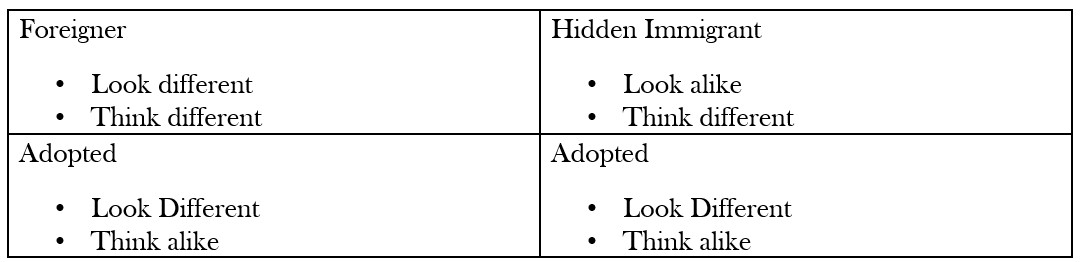
Van Reken describes experiences like this through categories such as these: TCKs often find themselves somewhere in the “Hidden Immigrant” and “Adopted” categories depending on where they are physically located. Perhaps Moses functioned as a “Hidden Immigrant” among the Hebrews while appearing “Adopted” within Egyptian society.
“An Egyptian Delivered Us”
Moses flees to Midian and encounters the seven daughters of the priest of Midian at a well. Other shepherds were harassing them, likely because there were no men present to protect them. Moses intervenes and helps them water their flock.
When the daughters return home unusually early, their father, Reuel, asks why they have returned so quickly. They respond: “An Egyptian delivered us out of the hand of the shepherds and even drew water for us and watered the flock.” (Exod 2:19)
An Egyptian.
Not a Hebrew.
Only a few verses earlier, the narrator emphasized Moses’s identification with the Hebrews. Yet to these Midianite women, Moses appears entirely Egyptian. He looks, speaks, and carries himself like one.
The narrative seems to intentionally highlight this tension.
Perhaps this feeling surfaces even more clearly later when Moses names his son Gershom, a name associated with being a “sojourner” or “stranger.” The theme of displacement seems to continue into Moses’s family life.
That feeling is not unfamiliar to many TCKs. Because they do not feel fully at home in either culture, they often live somewhere in between. Van Reken uses the term “interstitial” to describe this experience of existing in the spaces between worlds.
The Burning Bush and Belonging
What I find especially meaningful is that when God calls Moses, God roots him within a story and a people. At the burning bush, God introduces himself not only through his divine name, but also through Moses’s ancestors: “I am the God of your father, the God of Abraham, the God of Isaac, and the God of Jacob.” (3:6)
God calls Moses not only toward a mission, but also back toward a people.
This matters because TCKs often wrestle with identity and belonging. Many find connection most naturally with others who share similar experiences of displacement.
Also, Moses’s reluctance at the burning bush seems to involve more than fear or insecurity. Certainly, Moses is a fugitive. But perhaps there were deeper layers as well.
Van Reken observes:
The most serious problem related to learning multiple languages at an early age, however, is that some people never become proficient in their supposed mother tongue—the original language of their family roots and personal history.[2]
One of the most common things I hear from TCKs is language insecurity:
“I can’t speak Korean like native Koreans, but I also don’t speak English exactly like everyone else.”
Moses says: “Oh, my Lord, I am not eloquent… but I am slow of speech and of tongue.” (Exo 4:10)
I think this reflects more than a speech impediment. Perhaps Moses feels inadequate speaking the language and culture of the people he is being called to lead.
The text does not say this directly, of course. But it is difficult for me not to at least consider the possibility. And interestingly, God responds by providing Moses with a spokesperson: his brother Aaron.
And perhaps there is another subtle hint of this tension in the strange and difficult episode involving Zipporah circumcising their son (Exod 4:24–26).
The passage is famously ambiguous, and I do not want to press the point too far. Yet it is striking that just before Moses returns to Egypt to lead God’s covenant people, the narrative suddenly introduces a crisis involving the covenant sign itself.
Why had Moses apparently not circumcised his son?
The text never explicitly tells us. But it is possible that Moses’s life between multiple cultural worlds may also have contributed to some ambiguity regarding covenant identity within his own household. Moses is Hebrew by birth, Egyptian by upbringing, and now Midianite by marriage and residence. He lives between worlds.
And yet before he can fully step into his calling, something unresolved regarding covenant belonging must be addressed.
Interestingly, it is Zipporah (a Midianite outsider) who acts decisively in this moment. The scene is mysterious, but perhaps it reminds us that Moses’s identity and mission ultimately needed to be rooted not merely in cultural background, but in covenant belonging to God.
Why TCKs May Lead Differently
As the Exodus narrative unfolds, Moses emerges as Israel’s leader. And I cannot help but wonder whether some aspects of his in-between experience strengthened his leadership.
Moses repeatedly functions as a mediator between worlds. He speaks to Pharaoh within the language and structures of Egyptian power, yet he also identifies deeply with the suffering of Israel (Exod 2:11–12). Throughout Exodus, Moses constantly stands between different worlds: between Pharaoh and the Hebrews (Exod 5–12) and between God and Israel (Exod 32:11–14). Perhaps his unusual upbringing uniquely prepared him for this kind of role.
Moses also understood Egypt from the inside. He knew the culture of the royal court, the power structures, and likely even the language and customs of Egyptian leadership. While the text never explicitly says that his Egyptian upbringing helped him confront Pharaoh, it is difficult not to imagine that it mattered. Moses was able to move within spaces that would have been intimidating or inaccessible to many others. In many ways, he could navigate both Hebrew and Egyptian worlds.
Moses also seems open to wisdom from outside his own community. In Exodus 18, it is Jethro, a Midianite priest and Moses’s father-in-law, who observes Moses’s leadership and offers him practical advice regarding delegation and leadership structure (Exod 18:13–24). Jethro tells Moses, “Now obey my voice; I will give you advice” (Exod 18:19), and notably, Moses listens.
At a time when Israel was still forming its identity as God’s covenant people, Moses demonstrates a willingness to receive wisdom from someone outside Israel. Perhaps Moses’s own life between cultures made him more capable of recognizing wisdom beyond the boundaries of his immediate community. The narrative subtly portrays Moses as a bridge-builder, someone able to navigate and learn from multiple worlds.
But perhaps more importantly, much of Moses’s leadership takes place in the wilderness, a place of instability, transition, and uncertainty. Israel itself becomes a people living between worlds. They are no longer in Egypt, but they are not yet in the promised land. They are displaced, unsettled, and still discovering who they are as God’s covenant people (Exod 19; Num 14).
And in some ways, that sounds quite similar to the experience of many TCKs.
Perhaps Moses was uniquely prepared to lead people through transition because he himself had spent much of his life in transition. Long before Israel entered the wilderness, Moses already knew what it was like to live between identities, cultures, and places that never fully felt like home.
In that sense, the wilderness journey becomes especially fascinating. Israel eventually becomes what Moses already was: a people living between worlds. No longer Egyptian. Not yet settled in the promised land. A people whose identity was still being formed. A people learning that their ultimate sense of belonging would not come from Egypt, land, culture, or political security, but from belonging to God himself.
And perhaps this is one of the reasons Moses becomes such an effective mediator and leader. Again and again, Moses intercedes on behalf of the people, during the golden calf incident (Exod 32), the wilderness complaints (Num 11), the rebellion narratives (Num 14: 16), and moments of judgment and crisis. He constantly stands in the gap between God and Israel, navigating conflict, tension, fear, and uncertainty.
Many TCKs develop a similar ability to navigate multiple relational and cultural worlds. They often become bridge-builders, translators, mediators, and people who can empathize with those on different sides of cultural or social boundaries.
Van Reken notes several strengths often associated with TCKs:
- expanded worldview,
- cross-cultural sensitivity,
- adaptability,
- and the ability to navigate difference.
These qualities can be useful for someone leading a people through instability, transition, and wilderness.
Norma McCaig writes:
In an era when global vision is an imperative, when skills in intercultural communication, linguistic ability, mediation, diplomacy, and the management of diversity are critical, global nomads are better equipped in these areas…[3]
I cannot help but wonder whether Moses’s unusual upbringing uniquely prepared him for the role God had given him.
Perhaps Moses became a remarkable leader not merely despite his in-between identity, but in some ways because of it.
Conclusion
I fully recognize that some of these reflections are speculative. Exodus is not a modern psychological study of cultural identity. Yet I do think the biblical narrative leaves small clues that invite reflection.
- Moses’s story speaks meaningfully to those who live between cultures.
- Moses understood something about not fully belonging anywhere.
- And that is why the burning bush matters so deeply. Before Moses fully belongs anywhere else, he belongs to God.
I think that is an especially important truth for many TCKs in our churches today. Some grow up feeling too foreign in one culture and not enough in another. Some feel constantly in-between. Others carry quiet insecurities about language, identity, or where “home” really is. Yet Moses’s story reminds us that God is not hindered by those experiences. In fact, perhaps God often uses them.
What may feel like confusion, displacement, or cultural tension can also become a gift. The ability to navigate multiple worlds, understand different perspectives, adapt across cultures, and empathize with outsiders are not weaknesses. In many ways, these are deeply needed gifts in the church today.
And perhaps this is also an invitation to churches and leaders.
It is not enough for churches simply to welcome the children of immigrants who grow up among us. They also need a genuine sense of belonging. They need spaces where their unique experiences are understood rather than dismissed. They need opportunities to lead, serve, ask questions, wrestle with identity, and participate meaningfully in the life of the church.
Too often, immigrant churches unintentionally communicate that these young people are “not Korean enough,” while the broader culture reminds them that they are not fully part of the mainstream either. The church should not become another place where they feel caught in-between.
Instead, the church can become the place where they discover that their story matters, that their experience is not accidental, and that God may uniquely use them precisely because they have learned to live between worlds.
Moses became a remarkable leader not merely despite his in-between identity, but in some ways because of it.
And perhaps many TCKs sitting quietly in our churches today may one day become bridges, translators, leaders, pastors, missionaries, scholars, and peacemakers for the kingdom of God.
Notes
[1] Pollock, David C. Definition in The TCK Profile seminar material, Interaction, Inc., 1989, p. 1. Quoted in Ruth E. Van Reken, Third Culture Kids.
[2] Van Reken, Third Culture Kids, chapter 9.
[3] Quoted from Van Reken, Third Culture Kids, chapter 8.